
Saturday, February 5, 2011
(This is a follow-up post to “Will the Revolution Reach Syria?”)

Since the main focus of the media was Tahrir square, I had a hard time following-up on the what was happening in Syria. I was able, however, to stay up-to-date via the two hashtags #Syria and #Feb5.
I have gathered a list of links to the only worth-mentioning news snippets related to the “failed” Syrian demonstrations:
- Possible internet cut-offs in Syria:
http://on.mash.to/eIf5n8
- Syria blocks Facebook:
http://reut.rs/gJduHD
- Security was tightened in Syria in fear of contagious riots: http://bit.ly/f7b8Yk
- Photo of empty square, where demos were supposed to take place: http://bit.ly/ih8lBG
- Human Rights Watch urge Syria to free activist who called for demos: http://bit.ly/f7GwRQ
- Syrian supporters of Egyptian demos were assaulted by gang: http://bit.ly/dVkH7L
You can follow me on Twitter to stay up-to-date with the latest news on Lebanon and the Middle-Eastern region.
Saturday, February 5, 2011 Comments
Friday, February 4, 2011
Whether you’ve turned on your TV in the past couple weeks, read the papers, or been on any online media website, you are certainly informed, then, about the grim situation in the Middle-East: anti-government demonstrations have been going on for almost a month, with more countries joining this contagious pan-Arabic revolution every day.

.Having its birth in Tunisia, in December 2010, through what was dubbed the “Jasmine Revolution”, this epidemic of protests against dictators of the Arab world was successful in infecting several other Middle-Eastern and North-African countries: Lebanon, Egypt, Jordan, Yemen, Algeria, Sudan, Oman, Kingdom of Saudi Arabia, Morocco, Djibouti, and Mauritania (read this article for brief descriptions of the uprisings in each different country)
(Text continues after video)

One more country seems to be on the waiting list: Syria. While Egyptians were crowding Tahrir square during last Tuesday’s “million man march”, the Facebook page ”The Syrian Revolution 2011” was gathering thousands of supporters. The page calls for a “day of anger” to take place, today, Friday February 4, after prayer time in all Syria. So in less than 24 hours, we’ll know whether this call will be answered by the oppressed Syrian populace, or whether they will decide to avoid another terrible February, that of 29 years ago.

The question remains whether the people have reached their breaking point; and if so will they be able to overcome their dire memory of February 3, 1982, and raise their voices on February 4, 2011?
Update:
After submitting this post, I stumbled upon the following video, released recently by Mamoun Homsi, a former Syrian MP who was imprisoned by the government for politically opposing the ruling party. Below it is the English translation of his public address to all the Syrian, to join forces in the revolution against tyranny and oppression in Syria.
To be honest though, the video is a bit funny. However, you can’t deny that it is somewhat impressive to watch someone uttering a direct opposition to the Syrian government after so many years of oppressed silence.

English translation by NowLebanon.com:
Oh, great people of Syria
Oh, gentleman, scholars and clerics of Syria
Your country and your people are calling out for your conscience
Stand by your young men and your young ladies
Those that aim at supporting the Syrian opposition
To start the Jasmine Revolution
And to face the unjust and oppressing dictatorship
Rise for your dignity
Rise for your own living
Say no to corruption
No to deprivation
Say we want life
Walk out of the mosques and churches
And walk together hand in hand
From the different religions and affiliations
Arab, Kurds, Assyrians
Hold up the nation’s flag
Say altogether
Down with the dictatorship
Down with the dictatorship
Long live Syria
Long Live Syria
Long Live Syria
Photo Sources:
-Protests in Egypt - http://www.nydailynews.com/
-Damaged Hama in 1982 - http://egyptianchronicles.blogspot.com
Friday, February 4, 2011 Comments
Friday, January 21, 2011

Diplomatic activity in the upcoming few days is key to the avoidance of a civil war. Neither party is showing signs of concession to where the opposing group currently stands. Even more, both parties are using the media as a means to shift public support to their own favor.

On the other side, another serious event took place on Tuesday. Non-armed combatant of one of the opposing parties—Hizbullah—swarmed the streets of Beirut in a “show of force” (as The Daily Star calls it) . In just two hours, they were able to assemble in strategic locations and then disperse as quickly as they gathered; their intention was to show the other party that they are willing to use force in case things did not go as they please.
Every day, we watch a press conference by a certain representative of one of the two parties, attacking the opponent “team”. Unfortunately, the political discourse between our politicians has become a mockery. We, as Lebanese citizens, are witnessing the whole Lebanese media being transformed into a virtual battlefield, where the two opposing forces haven’t yet engaged in an actual armed conflict; however, through their use of political propaganda, they are both kicking the hornets’ nest.
So again I tell you, I am not a political analyst nor a fortune teller; however, I am strongly pessimistic when it comes to our political situation. In the end, it makes me sad to say I am almost certain that the current “cold war”, which has been crippling the country for so many years, and which is now being escalated, will soon turn into a real armed confrontation: a new civil war!

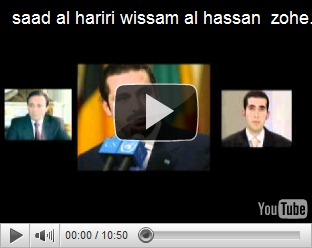
(Image sources: Photo of Joubran Bassil: forum.tayyar.org/ — Photo of Saad al Hariri: NowLebanon.com)
Friday, January 21, 2011 Comments
Tuesday, June 15, 2010
A friend played me a documentary, yesterday, titled “It’s About Time Lebanon” by Lebanese filmmaker Pierre Dawalibi, released in 2006. I was really taken by the emotional footage intercut into this summary, reviewing the 30 years of war in Lebanon. Even though, it has been 4 years since it was released, I believe it is worth posting on my blog. This short film condemns all political movements, fueled by sectarian hate and corruption, by conveying a message of peace, love and tolerance.

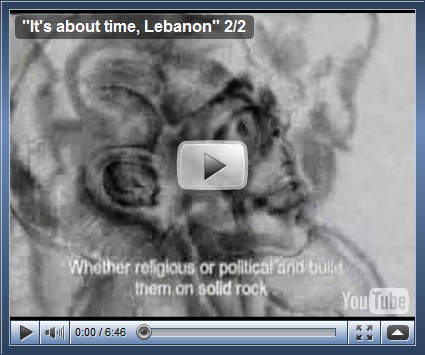
(via YaLibnanTV)
Tuesday, June 15, 2010 Comments
Saturday, June 12, 2010
(Despite the on-going political and economic instability in Lebanon, fueled by the harboring of religious fundamentalism, the New York Times named Beirut as the best place to visit in 2009.)
Lebanon is one of the few countries that weren’t affected by the subprime crisis. Economists explain that the three main reasons behind this immunity are: the central-bank’s wise decision to prohibit commercial banks from stepping into subprime territory; the fact that Lebanon’s industry is mainly services-based; and the boom in touristic activities, which has luckily coincided with the worldwide crisis. Tourism has always been a significant contributor to our national income, and every summer people anticipate a large touristic turn up, hoping for a financial stimulus and a boost of the ever stagnating economy.

In terms of touristic attractions, Lebanon is well endowed with countless historical relics and monuments, diverse national museums, and an abundance of eye-candy natural vistas. These fascinating national treasures have attracted millions of tourists to this small Mediterranean country, throughout the years—the majority coming from other Arab countries. In the last decade, however, different factors have become the main touristic magnet: the large variety of leisure activities and the vibrant night-life.

Lebanon is the only Arab country in which people, with the exception of religious extremists, enjoy a liberal lifestyle. Even though religion plays an important role in the government, it is still regarded as a significantly moderate nation, if compared to the neighboring Islamic republics. Nowhere else in the Arab-world do people enjoy the laissez-faire way of life, such as the one offered in Lebanon. During the last ten years, tourists from Saudi Arabia, the United Arab Emirates, Qatar, Kuwait and Jordan have been swarming Lebanese shopping malls and have become regulars at the clubbing scene in Beirut. These “pious” Muslims, have found the optimal locale—in terms of luxury and freedom from their dictatorial religious dogmatism—to spend the billions of US dollars, hibernating in their nine-digits-interest-swelling-secretly-held bank accounts (Islamic doctrine prohibits Muslims from earning interest on their money. However, the Banking Secrecy system in Lebanon opens a completely private backdoor for those petroleum giants.)

Saturday, June 12, 2010 Comments
Tuesday, June 1, 2010

MSNBC reported that the raid, which took place around 5:00am on Monday, resulted in the deaths of 9 activists and dozens of serious injuries, on board of the Mavi Marmara (one of the 6 ships carrying the aid to Gaza and on which the confrontation was the most hostile). The IDF later announced that soldiers opened fire in act of self-defense, after being attacked by the activists on board. They released the following footage (and this one) showing heavy fighting on the deck of the above mentioned vessel.

After this violent strike, the IDF took control of the ships and towed them to shore. Upon arrival, injured civilians were taken to four different hospitals while many of the activists, who were on board of the ships, were arrested and questioned – the government had planned these detentions prior to the sailing of the flotilla. The authorities had already set up a detention and interrogation facility capable of handling hundreds of people, reported Ma’ariv, a daily tabloid published in Tel Aviv, the port will be turned into a “giant interrogation room”. Most of what was reported on this bloody incident was from Israeli sources. A very small number of activists were quoted on the matter. An American passenger stated "I'm not violent. What I can tell you is that there are bruises all over my body. They won't let me show them to you".
Different opinions were being shaped in response to this hostile blockade. In many countries a series of anti-Israel rallies was triggered, condemning the hostile measures taken by the IDF (the picture on the left is taken in front of the white house). On the other hand, some people justified the Israeli actions taken against the freedom flotilla. They believe the activists were the ones who initiated the hostility – their only source of information is the IDF claims along with a prejudice against Muslims.
Given the unreceptive attitude on the whole idea of the flotilla, which the Israeli government has been advertising for weeks, as well as their clear intentions to intercept it, it is more likely that the IDF had already planned this “terrorist” attack against the activist on board of the Marmara. The following video was uploaded to YouTube by WilliamTomg, yesterday, and it contains the footage taken on board of the Marmara during the assault by the IDF. Three reporters (one of whom is speaking in English) are describing the actual scene; at one point, they report that the activists are raising a white flag for the Israeli soldiers but they are still shooting at them. This video gives a clear perspective on how the events unfolded. If you are going to watch the video do not worry about the lack of subtitles, all three reporters are disclosing the same information in three different languages (English, Arabic and Turkish).

Tuesday, June 1, 2010 Comments
Wednesday, May 26, 2010

Today I posted my first article (originally posted here) on the MideastYouth website. It is an active community of young men and women from the Middle-east, writing about a wide variety of interesting subject. With their open-minded attitude, they are trying to show the world that nothing can hold them back from expressing their views about the experiences they are living in the Arab world.
This vibrant group of free-thinkers are getting the exposure they deserve in the regional media, which will definitely help them in spreading the word throughout the Middle-East.
Make sure you visit this great website anytime you feel like enjoying a good read or if you would like to stay up-to-date with the latest news on Religion, Atheism, Secularism, Politics, Lifestyle and many other interesting topics related to this side of the world, written by a large number of fresh voice from the young Arab community.
Wednesday, May 26, 2010 Comments
Monday, May 24, 2010

While politicians are taken by this naive campaign, the people are looking forward to a totally different kick-off: The 2010 Fifa World-Cup. For them, local politics is a joke, and the situation hasn’t changed for decades. In Lebanon, the same figures have been running the country for as long as they can remember. The World-Cup, however, is a totally different story. Even though our national soccer-team has never been qualified to play in this tournament, this competition has always been the most anticipated of all events.

When you observe this completely different reality, overwhelming Lebanon for this short period of time, you realize that people, when left non agitated by our unethical politics, are able to overlook the differences among them, and it makes you wonder whether this could become a permanent reality simply by adopting political “Fair Play”.
Monday, May 24, 2010 Comments
Saturday, May 22, 2010
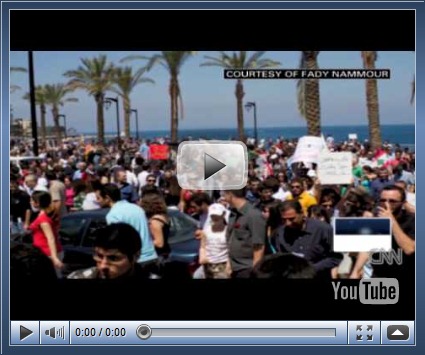
Thousands of brave secularists marched in Beirut, on the 25th of last month, rallying for a secular government in Lebanon and the abolition of political sectarianism. Those courageous men and women proved to the world that even in a region such as the Middle-East, in which freedom of expression is conditional, it is possible to trespass this red-line drawn by our pseudo-democratic governments.
Another group of activists, the Lebanese homosexual pride, Helem (arabic for “Dream”), organized an event last Monday to celebrate the International Day Against Homophobia and Transphobia (IDAHO), under the title “I am queer”. One of the main goals of this demonstration was the abolishment of article ‘534’ of the Lebanese penal code ‘534’, punishing “sexual intercourse contrary to nature” (visit this link for a complete list of goals set by Helem). This is not the first protest by this group, in which they try to pressure the parliament to eliminate discrimination against homosexuals. The first public protest took place in February 2009 (see video below), which came as a shock to many Lebanese citizens. This first event was launched as a protest against the violent beatings of two gay men (violent assaults on homosexuals have been taking place for a long time in Lebanon; beatings by policemen were also reported on a couple occasions). This, however, did not stop the dedicated activists from rallying again; surely, they will not rest until both the government and the public condemn such injustice.

Saturday, May 22, 2010 Comments
Monday, May 17, 2010
A couple of days ago my friend and I were at my apartment having coffee and discussing random subjects. At one point during our conversation we came across the subject of religion. Mazen is a Durzi – a religious sect derived from Islam, but which has many unique aspects to it. He told me that he is a believer but not a practicing one. In fact the structure of the Durzi faith is very complicated and not all Druzes are allowed to read their Holly Book (al-Hikma “The Wisdom”); only when you decide to become a “Sheikh” you are granted access to the scriptures. Most believers spend all their lives without even looking at the book once and they base their beliefs on the teachings of their parents, who, in turn, are most likely to have received them from their own parents. The Druzes are a minority compared to the other Islamic sects and the majority of them reside Syria, Lebanon and Israel. They do not marry outside their community and anyone who does is cast out.
We stayed on the subject for quite some time and I was really enjoying the discussion. I was able to strike him with powerful arguments that challenged his entire belief system. I could tell from his reactions to my reasoning that he had never before engaged in a conversation with a non-believer. The discussion became really interesting when he told me that he believes in reincarnation. The first question I asked him was “How would you explain the population growth if you believed that every time one person is born another one should already be dead in order for his or her soul to be transferred to the new host?” I was really shocked by the answer he gave me, mainly because he is a well educated person and I didn’t expect him to reply with such irrationality. He said “the truth is that the population is NOT growing and when God first created human beings, he created 6 Billion people right from the beginning” His reply really surprised me and it took me a while to ask him another question; I said “but what about the statistics which show the growth in the world’s population? I mean take Lebanon for example; the data proves that the number of Lebanese citizens has more than doubled since 1960. How would you explain that?” He replied by saying that the population of some other country must have decreased then, and also that there is no way I could prove these statistics are trustworthy.

After listening to his logic, I kept on probing his viewpoint and showing him how absurd his reasoning was. I knew he was becoming uncomfortable with his own approach, the more I spoke. However, like any other person basing his beliefs on blind faith, he wasn’t letting go of his convictions easily. I ended the conversation hoping that he will take into consideration my observations and maybe he will no longer take religious “truths” at face-value.
Monday, May 17, 2010 Comments


